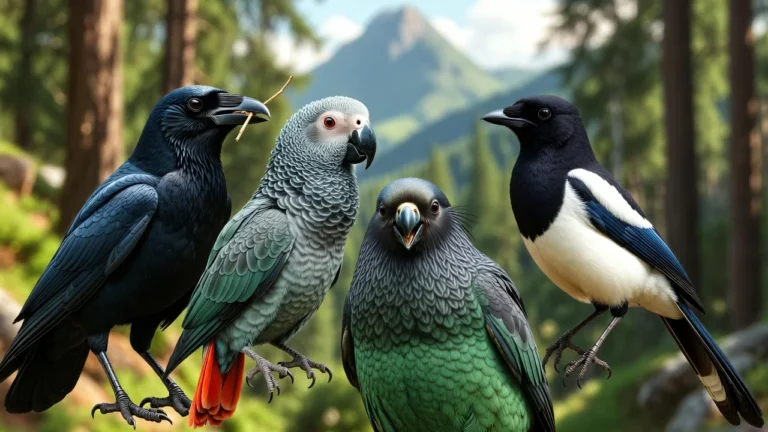
Bird intelligence showcases some of nature’s most fascinating bird behaviors. When people ask what the smartest bird is, the answer depends on how you measure intelligence. New Caledonian crows manufacture tools from scratch. African grey parrots understand abstract concepts like zero. Keas solve probability puzzles that stump most mammals.
Scientists measure avian intelligence through problem-solving tests, tool use, memory capacity, and social cognition. The results consistently place corvids (crows, ravens, jays) and parrots at the top, often matching or exceeding great apes in specific cognitive tasks.
How Scientists Measure Bird Intelligence
Brain size matters less than you’d think. A male crow’s brain weighs about 7.5 grams compared to a human’s 1,400 grams, yet crows perform tasks that rival chimpanzee cognition. The key is neuron density.
Dr. Nathan Emery from Queen Mary University of London found out that the neuron density in corvids is similar to that of primates. The pallium in birds, which is functionally comparable to our cerebral cortex, contains computational power that they use for complex thinking.
Researchers usually measure bird intelligence using specific experiments, such as puzzle boxes requiring sequential steps, delayed gratification tests, mirror self-recognition, and causal reasoning challenges. These aren’t techniques, but scientific ways to know cognitive abilities that some species use daily in the wild.
The 10 Smartest Bird Species
Here are some of the bird species that top cognitive tests measuring problem-solving, memory, and tool use:
New Caledonian Crow
The smartest bird in the world is arguably the New Caledonian crow. These birds manufacture hooked tools from twigs and leaves. It’s a skill that requires an understanding of physics and materials.
In 2002, a captive New Caledonian crow named Betty stunned Oxford University researchers by bending a straight wire into a hook to retrieve food from a tube. She’d never seen this done before. The spontaneous innovation showed meta-tool use, the ability to use one tool to create another.
Key abilities:
- Manufacturing hooked and stepped tools from natural materials
- Solving eight-step puzzles requiring sequential planning
- Passing tool-making knowledge across generations through cultural transmission
- Demonstrating understanding of cause-and-effect in tool design
Cultural transmission of tool designs is seen in wild species. Different crow groups make distinct tools and pass this technique down through generations. Professor Alex Kacelnik’s studies showed that crows solve complex puzzles by using memory.
African Grey Parrot
Dr. Irene Pepperberg spent 30 years studying Alex, an African grey parrot who learned over 150 words and understood concepts most animals can’t grasp. Alex identified colors, shapes, and materials. He counted objects up to six. He understood “same” and “different.”
Most remarkably, Alex understood the concept of zero, an abstract idea that took even humans thousands of years to develop mathematically. When shown a tray with no objects of a particular color, he correctly answered “none.”
Cognitive achievements:
- Vocabulary of over 150 words with a clear understanding
- Ability to grasp abstract ideas, including zero
- Reasoning skills similar to a 5-year-old child
- Emotional awareness comparable to a 2-year-old human
- Ability to sort objects using several features at once
Research in Animal Cognition shows these parrots understand concepts like zero, colors, and shapes, and can communicate intentionally.
Kea (New Zealand Alpine Parrot)
Keas are the world’s only alpine parrots, and their mountain environment shaped exceptional problem-solving abilities. A 2020 study from the University of Auckland showed keas understand statistical probability. That’s something only great apes and humans had previously demonstrated.
Researchers gave keas jars with different mixes of preferred and non-preferred tokens. The birds usually chose the jars with better odds, showing they could judge probabilities before deciding.
Intelligence markers:
- Understanding basic probability, rare among birds
- Solving complex lock mechanisms
- Working with other keas to solve problems
- Coming up with new solutions faster than most species tested
- High levels of play linked to flexible thinking
Dr. Auguste von Bayern at the Max Planck Institute found keas innovate solutions to novel problems faster than most tested species. They’ve been filmed dismantling car windshield wipers, unzipping backpacks, and solving puzzles purely for entertainment.
Common Raven
Ravens demonstrate social intelligence that rivals primates. They understand third-party relationships and engage in complex vocal communication, from alarm calls to varied vocalizations used to coordinate with their flock. Research shows ravens engage in tactical deception, giving false alarm calls to scare competitors away from food.
Social and cognitive skills:
- Waiting over 15 minutes for a better reward, longer than most mammals
- Understanding relationships between other individuals
- Using deception, including false alarm calls
- Choosing partners based on their skills
- Solving problems together that require coordination
Research from the University of Vienna found that ravens prefer partners based on social bonds, cooperating more successfully with friends. This shows they can judge others’ abilities and plan ahead.
Western Scrub Jay
These jays have episodic-like memory. They remember what they stored, where they hid it, and when. Professor Nicola Clayton at Cambridge University found that scrub jays recall these details for over nine months with about 90 percent accuracy.
More impressively, scrub jays adjust their caching behavior based on who’s watching. If observed by another bird, they’ll return later alone and re-hide the food in a new location. But they only do this if they’ve stolen food themselves before, suggesting they understand others’ knowledge states.
Memory and theory of mind:
- Remembering what they stored, where it was, and when, with about 90 percent accuracy
- Recalling food locations for over nine months
- Understanding what other birds know
- Re-hiding food when another bird has seen it
- Only re-hiding if they have stolen food before
This theory of mind, the ability to understand what others are thinking, was long considered uniquely human. Scrub jays challenge that idea.
Eurasian Magpie
In 2008, researchers at Ruhr University Bochum published breakthrough findings: Eurasian magpies passed the mirror self-recognition test. Scientists placed colored stickers on the birds’ throats (visible only in a mirror) and watched as magpies tried removing the marks after seeing their reflections.
Self-awareness indicators:
- Recognizing themselves in a mirror, something only a few species can do
- Trying to remove marks they can see only in a reflection
- Protecting stored food by making fake hiding spots
- Using several ways to prevent theft
- Knowing when they are being watched
Self-recognition shows self-awareness, a high level of thinking. Magpies also protect their stored food in smart ways, using tricks like fake hiding spots to confuse other birds.
Goffin’s Cockatoo
What makes Goffin’s cockatoos extraordinary is they innovate tools despite never using them in the wild. Dr. Alice Auersperg at the University of Veterinary Medicine Vienna presented captive Goffin’s with a five-lock puzzle box. The birds figured out the correct sequence without training.
A cockatoo named Figaro made tools on its own, using wood splinters to reach nuts it could not get. It had not been taught; Figaro figured out the solution by understanding the problem.
Tool innovation abilities:
- Making tools on their own without being taught
- Solving puzzles with five locks in order
- Knowing how objects work, like weight, strength, and length
- Choosing the right tool for the job
- Changing materials to make tools work better
Goffin’s cockatoos can select suitable tools for specific tasks and modify materials when and as needed, showing advanced physical cognition.
Clark’s Nutcracker
Clark’s nutcrackers have one of the best memories in the animal world. Every fall, each bird hides 30,000 to 100,000 pine seeds across a huge area, about 300 square kilometers. Then, throughout the winter, they find almost every single one with amazing accuracy.
Memory capacity:
- Remembering 30,000 to 100,000 hiding spots
- Covering an area of over 300 square kilometers
- Keeping track of caches for more than nine months
- Having a larger hippocampus to support memory
- Adjusting for snow and changes in the landscape
Research shows nutcrackers have enlarged hippocampi, the brain areas that handle spatial memory, sized to match their memory needs. Field studies confirm nutcrackers fly directly to cache sites, even in altered landscapes. This isn’t random searching.
Carrion Crow and Hooded Crow
Japanese carrion crows invented a technique that went viral across their population: dropping hard-shelled nuts at pedestrian crossings, waiting for cars to crush them, then retrieving the meat when traffic lights turned red.
This behavior shows understanding of traffic patterns, tool use (cars as nutcrackers), and timing. It wasn’t taught. Crows observed the environment and innovated.
Problem-solving demonstrations:
- Understanding traffic light timing
- Using tools in creative ways, like cars to crack nuts
- Understanding water levels, like in Aesop’s fable
- Thinking skills similar to those of 5 to 7-year-old children on water tasks
- Telling differences in objects, like sink or float, heavy or light
Believe it or not, that old crow story isn’t just a story. A 2009 study from Cambridge University found crows can figure out water puzzles like 5 to 7-year-old kids. Give them a tube of water with floating food they can’t reach, and they’ll start dropping stones to raise the level. They even know which objects sink or float and pick the smartest ones to get the job done.
Blue Jay
Blue jays show vocal mimicry, social complexity, and tricky communication. They copy hawk calls to scare other birds away from food, a clever use of false information.
Cognitive and social abilities:
- Copying hawk calls to trick other birds
- Remembering thousands of hiding spots
- Planning where to store food for the future
- Learning foraging skills from other birds
- Changing behavior depending on danger or food availability
Research shows blue jays plan where to store food for the future and learn from other birds. They also change their behavior depending on danger, food, and social situations, which takes smart thinking.
What Makes These Birds So Intelligent?
Bird intelligence grew to help them survive. Corvids and parrots share traits that improve their thinking skills. Here’s what makes these birds so smart:
Long Lifespans Support Learning
Long lifespans allow extended learning periods. Ravens live 15 to 20 years in the wild; parrots can live up to 60 years, depending on species. Longer lives mean more time to accumulate knowledge and benefit from learned skills.
Complex Social Lives Improve Thinking
Birds that manage friendships, dominance, and cooperation face mental challenges. Keeping track of relationships and predicting others’ behavior pushes their brains to work harder.
Flexible Diets Encourage Creativity
Omnivorous corvids and parrots deal with a variety of foods that need different ways to get at them. Birds that come up with new foraging tricks can reach more resources.
Extended Parental Care Teaches Skills
Young crows and parrots stay with their parents for months or even years. They learn by watching and practicing, passing knowledge from one generation to the next.
Brain Structure Provides the Tools
Bird brains are different from mammal brains, but evolution gave them similar abilities. The high density of neurons in the pallium lets them process information like the mammalian cortex does.
Intelligence Comparisons: Birds vs. Other Animals
When scientists directly compare birds and mammals, the results are often surprising. In many cognitive tests, corvids and parrots perform just as well as great apes, and sometimes even better. These birds are not just clever in small ways. They can rival the problem-solving skills of primates in certain tasks.
Take New Caledonian crows, for example. They can figure out complex tool-use problems at the same level as chimpanzees. African grey parrots can reason through challenges that most monkeys cannot handle. Even keas, a type of parrot from New Zealand, show an understanding of probability that surpasses what many mammals can do in laboratory tests.
This does not mean birds are smarter than mammals in every way. Intelligence is specific to the kind of problem being solved. Dogs, for instance, are excellent at reading human social cues, a skill many birds struggle with. Primates often perform better in some spatial reasoning tasks where birds are less capable.
The bigger lesson here is that intelligence does not depend on one kind of brain or one evolutionary path. Birds and mammals developed their smarts separately, each shaped by the problems they needed to solve to survive. Even though their brains look very different, they can reach similar levels of thinking, reasoning, and problem-solving in areas that matter most to them.
The Smartest Bird? It Depends How You Measure
Asking “which bird is the smartest” doesn’t have one clear answer. Different birds excel at different types of intelligence.
- For making and using tools: New Caledonian crow
- For communication and symbolic thinking: African grey parrot
- For remembering locations: Clark’s nutcracker
- For social strategy: Common raven
- For problem-solving and creativity: Kea or Goffin’s cockatoo
- For self-awareness: Eurasian magpie
Each bird developed skills that helped it survive in its environment. What counts as “smart” depends on which ability you value most. Observing these intelligent behaviors in action makes birdwatching even more rewarding.
FAQs
The smartest birds include New Caledonian crows, African grey parrots, keas, common ravens, and Western scrub jays. These species consistently rank highest in cognitive tests measuring problem-solving, memory, tool use, and social intelligence.
The New Caledonian crow is widely considered the smartest bird in the world. These crows manufacture hooked tools from twigs, solve eight-step sequential puzzles, and demonstrate meta-tool use, using one tool to create another.
Crows rank among the smartest birds, particularly New Caledonian crows and carrion crows, but they share top rankings with ravens, parrots, and keas. Crows excel at tool innovation, problem-solving, and urban adaptation. They understand water displacement, use traffic patterns to crack nuts, and remember human faces for years. However, African grey parrots surpass crows in communication and abstract concept understanding.